SEO GLOSSARY
SEO Terms Explained in Plain English
SEO is full of jargon. This glossary explains the terms you will hear from agencies, tools and Google itself — from backlinks and Core Web Vitals to AI Overviews and GEO — in simple language, without the sales pitch.
What Is SEO?
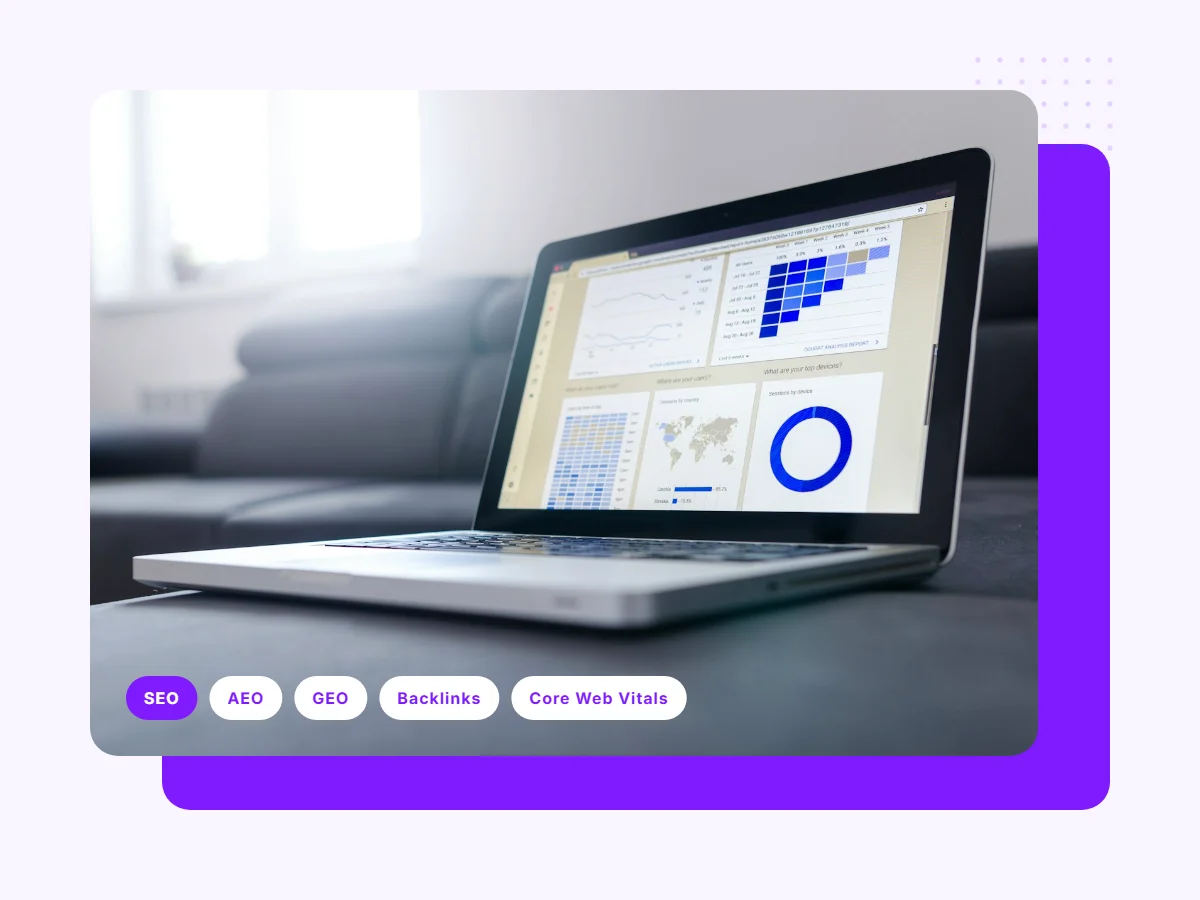
SEO (search engine optimisation) is the process of improving a website so it appears higher in unpaid search results on Google and other search engines. It combines technical work, helpful content and authority from other websites. In 2026, SEO also includes making your business visible in AI-generated answers from tools like Google AI Overviews, ChatGPT and Perplexity.
A–Z
The OneRanked SEO Glossary
#
301 Redirect
A permanent redirect that sends visitors and search engines from an old URL to a new one, passing most of its ranking value.
A
Above the Fold
The part of a page visible before scrolling. Your main message and call to action should appear here.
AEO (Answer Engine Optimization)
Structuring content so search engines and AI tools can quote it as a direct answer, for example in featured snippets or voice results.
AI Overviews
AI-written summaries Google shows above organic results for some searches, citing a small number of sources.
Alt Text
A short text description of an image that helps search engines and screen readers understand it.
Anchor Text
The clickable words in a link. It tells Google what the linked page is about.
B
Backlink
A link from another website to yours. Relevant, trusted backlinks are one of Google’s strongest ranking signals.
Bounce Rate
The share of visitors who leave without interacting further. In GA4 it is the opposite of engagement rate.
Breadcrumbs
A navigation trail such as Home › Services › Local SEO that helps users and search engines understand site structure.
C
Canonical Tag
A tag that tells search engines which version of similar or duplicate pages is the main one.
Citation
An online mention of your business name, address and phone number, usually on a directory. Important for local SEO.
Core Web Vitals
Google’s user-experience metrics: Largest Contentful Paint, Interaction to Next Paint and Cumulative Layout Shift.
Crawling
The process search engine bots use to discover pages by following links and sitemaps.
CTR (Click-Through Rate)
The percentage of people who click your result after seeing it in search.
D
Disavow
A file you submit to Google asking it to ignore specific harmful backlinks. Use only when there is real risk.
Domain Rating (DR)
An Ahrefs score from 0 to 100 estimating the strength of a website’s backlink profile. It is not a Google metric.
E
E-E-A-T
Experience, Expertise, Authoritativeness and Trustworthiness — qualities Google’s guidelines use to judge content quality.
Entity
A clearly defined thing — a business, person or place — that search engines and AI tools can recognise and connect to facts.
F
Featured Snippet
A highlighted answer box at the top of some Google results, taken from one web page.
G
GEO (Generative Engine Optimization)
Making your brand visible and cited in AI-generated answers from tools like ChatGPT, Gemini and Perplexity.
Google Business Profile
Google’s free business listing that appears in Maps and local results. Formerly Google My Business.
Google Search Console
A free Google tool that shows how your site performs in search and reports indexing and technical issues.
Guest Post
An article written for another website, usually including a link back to your site.
H
H1 Tag
The main heading of a page. Each page should have one clear H1 describing its topic.
I
Indexing
When a search engine stores a page in its database so it can appear in results.
Internal Link
A link from one page on your website to another page on the same website.
K
Keyword Difficulty (KD)
An estimate of how hard it is to rank in the top 10 for a keyword, based on competitors’ backlinks.
Keyword Cannibalization
When several of your own pages target the same keyword and compete against each other.
L
Link Building
The process of earning backlinks from other websites to increase your site’s authority.
llms.txt
A proposed text file that lists a website’s key pages in plain language to help AI tools understand it.
Local Pack (Map Pack)
The group of usually three Google Maps results shown for local searches.
Long-Tail Keyword
A longer, more specific search phrase with lower volume but often higher buying intent.
M
Meta Description
The short summary under your title in search results. It influences clicks rather than rankings directly.
N
NAP
Name, Address and Phone number. Keeping NAP consistent across the web strengthens local SEO.
Nofollow Link
A link with an attribute telling search engines not to pass ranking credit, often used for ads or user content.
O
Off-Page SEO
Actions outside your website that build authority, such as backlinks, mentions and reviews.
On-Page SEO
Optimising elements on your own pages — content, titles, headings, links and images.
Organic Traffic
Visitors who arrive from unpaid search results.
P
PBN (Private Blog Network)
A group of websites built only to create links. Google treats them as spam.
People Also Ask
A Google results box of related questions with expandable answers.
R
Robots.txt
A file that tells search engine bots which parts of a website they may crawl.
S
Schema Markup
Structured data code that helps search engines understand content and can unlock rich results.
Search Intent
The goal behind a search — to learn, compare, buy or find a specific site.
SERP
Search Engine Results Page — the page you see after searching.
Sitemap (XML)
A file listing the pages you want search engines to find and index.
T
Technical SEO
Optimising a site’s infrastructure — speed, crawling, indexing and structure — so it can rank.
Title Tag
The clickable headline of your page in search results and one of the strongest on-page signals.
Topical Authority
How completely and expertly a website covers a subject, built through connected, high-quality content.
W
White-Hat SEO
SEO methods that follow search engine guidelines and build lasting results.
KEEP EXPLORING
Related SEO Services & Resources
FREE, NO-OBLIGATION AUDIT
Rather Have Experts Handle the Jargon?
Get a free SEO audit and we’ll explain exactly what your website needs — in plain language.